
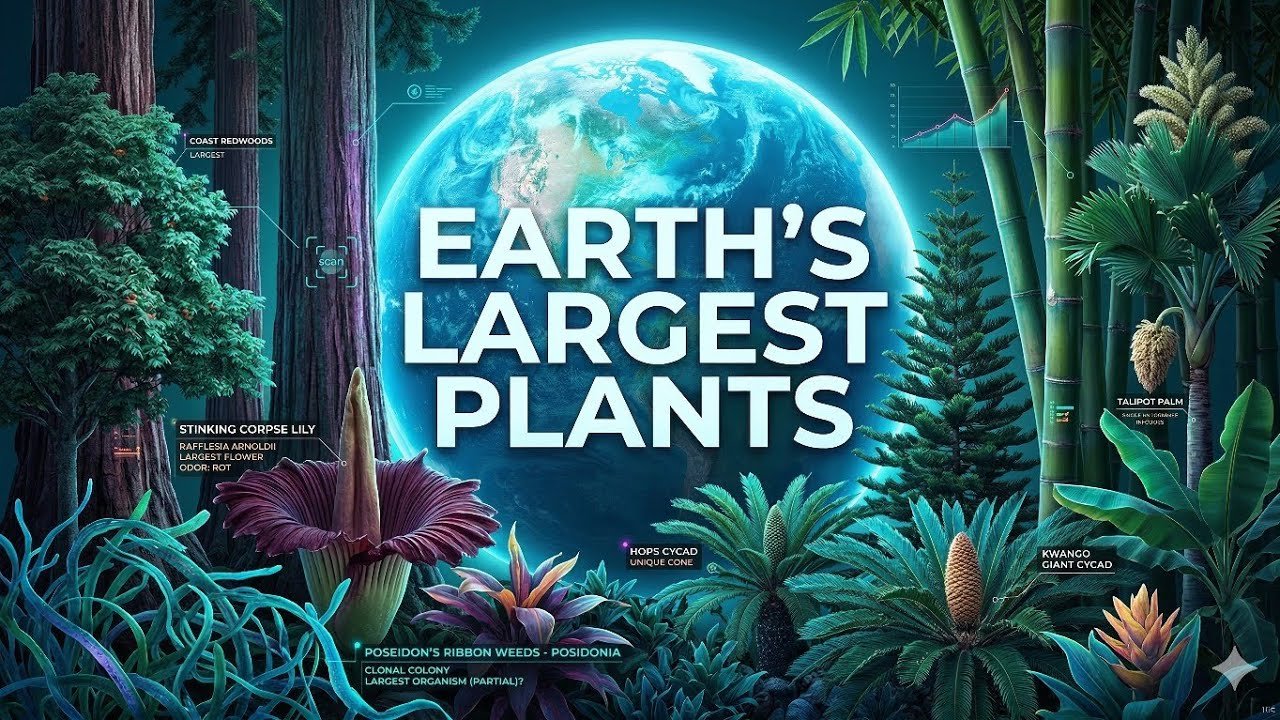
When you think of the largest living organism on Earth, your mind probably jumps straight to a majestic Redwood tree reaching into the sky or perhaps the colossal Blue Whale roaming the deep ocean. However, nature loves a good plot twist, and the planet’s undisputed spatial champion isn’t standing tall in a forest or swimming through the open sea. It is sitting quietly under the clear, shallow waters of Shark Bay in Western Australia, swaying gently with the tide.
Scientists have discovered that a single continuous meadow of marine seagrass, specifically a species known as Posidonia australis, covers a staggering 180 kilometers. That is roughly the distance of a two-hour highway drive, or approximately 20,000 football fields combined, all belonging to one single plant. This aquatic giant does not rely on a complex network of distinct individual seedings, but rather functions as one immense, interconnected living organism.
The discovery sent shockwaves through the scientific community when researchers from the University of Western Australia and Flinders University sampled seagrass shoots across the bay. Initially, the team intended to measure the genetic diversity of the region’s seagrass beds to understand how to protect them. Instead, genetic testing revealed something mind-boggling: every sample taken across the vast expanse shared the exact same DNA code.
To put this incredible scale into perspective, the plant is effectively a massive single clone that has continually expanded across the seabed over thousands of years. While giant trees grow upward, this seagrass spreads outward using underground stems called rhizomes. These rhizomes creep along the sandy seafloor, sending up fresh green shoots every few centimeters to catch the sunlight filtering through the shallow water.
Geneticists estimate that based on its current size and standard growth rates of seagrass rhizomes, this single organism is at least 4,500 years old. It was taking root around the same time the ancient Egyptians were building the Great Pyramids of Giza. Through centuries of climate shifts, changing water levels, and ecological changes, this resilient underwater meadow has simply kept growing uninterrupted.
What makes this underwater marvel even more fascinating to evolutionary biologists is its secret weapon for survival: it is a polyploid organism. Most plants and animals inherit half their chromosomes from one parent and half from another, but this seagrass inherited 100% of the genome from both of its parent plants. Instead of having two sets of chromosomes, it possesses four, giving it a massive reservoir of genetic tools to handle environmental stress.
This extra set of genetic material turned out to be crucial, allowing the plant to thrive in conditions that would stress or kill ordinary marine vegetation. Shark Bay presents extreme environmental challenges, featuring salinity levels twice as high as typical seawater alongside temperature fluctuations ranging from chilly winter currents to scorching summer surface heat. While other plants might wither under such harsh conditions, this super-clone flourishes without breaking a sweat.
Unlike standard marine flora that relies heavily on sexual reproduction, flowering, and seed distribution to adapt, this giant plant largely gave up on traditional breeding. Because seed production requires significant energy and genetic reshuffling, the seagrass instead relied entirely on vegetative cloning to survive. It simply expanded its territory foot by foot, cloning itself over millennia to master its immediate environment.
The ecological role played by this sprawling underwater organism cannot be overstated. Beyond its impressive credentials as an evolutionary phenomenon, the vast meadow acts as a critical sanctuary for marine life. It provides food, shelter, and nursery grounds for turtles, dugongs, dolphins, fish, and countless invertebrate species that call Shark Bay their home.
Furthermore, marine seagrass beds are powerhouses when it comes to combating climate change through carbon sequestration. Plants like Posidonia australis trap organic carbon in the sediment beneath them at a rate up to 35 times faster than tropical rainforests. This ancient Australian giant is not just surviving; it is actively acting as a massive natural filter and carbon sink for our planet.
Discoveries like this serve as a humbling reminder of how much of the natural world remains a mystery waiting to be unraveled. For decades, locals and scientists alike sailed across Shark Bay assuming they were looking at a vast forest of thousands of distinct individual plants. It took modern DNA fingerprinting technology to reveal that what looked like a forest was actually just one single, extraordinary tree.
As climate change continues to impact ocean temperatures global systems worldwide, understanding how this ancient clone survived for millennia becomes vital for marine conservation. Scientists are currently studying the plant’s stress-response mechanisms to help restore other threatened seagrass beds around the globe. By learning the secrets of this underwater giant, we might just unlock better strategies to safeguard our oceans for generations to come.